

Before we begin
Why do I need to make my brand guidelines AI-readable?
When your brand guidelines are AI-readable, generative AI tools are better able to produce on-brand content. Instead of producing generic content based on their training, or content based on the content of people’s prompts (which can vary in quality and completeness), AI can draw on your brand truth. This means more consistent and reliable output, and less human review and correction.
Why can’t AI just use my existing brand guidelines?
AI can’t always read traditional brand guidelines because they were written for human interpretation. AI thrives on specificity. But most brand guidelines follow a narrative format used to engage and inspire human readers. These often leave room for interpretation, which people fill with knowledge, but AI fills with guesswork. To avoid brand missteps, it needs explicit instruction.
For more information on this topic, next read.
10 steps to AI-ready brand guidelines (and on-brand generative content)
The ten steps below cover everything you need to do to create AI-readable guidelines. This includes changes to your guidelines themselves, and improvements to your infrastructure so that AI tools can access them.
Think of it as a walk-run-fly model.
- Walk – Update your guidelines to make them more useful to AI when people feed them into tools like Claude and ChatGPT
- Run – Upgrade from static PDF guidelines to a dynamic brand system to make guidance easier for people and AI tools to access and use
- Fly – Colocate brand and digital assets in a single source of truth, to enable autonomous, governed AI workflows
We’ve linked out to other useful resources throughout. This is a big topic!
1. Start with a mindset shift
We’re all familiar with traditional brand guidelines. Descriptive, aspirational, narrative documents that mix explanation and inspiration, rallying people behind the essence of a brand.
Don’t worry, they’re not going to be replaced with script, code, and sterile language. They’re just going to be improved to make them work for people and AI tools simultaneously – by improving structure, removing ambiguity, and making them accessible automatically.
To help AI tools retrieve, interpret, and apply your brand correctly, they need to be:
- Structured: broken into clear, reusable rules and fields
- Specific: written with concrete instructions, not vague adjectives
- Contextual: able to change depending on audience, channel, market, or use case
- Connected: linked to approved assets, templates, metadata, and workflows
- Governed: version-controlled, approved, and always up to date
We’ll show you how to do this throughout the steps below.
2. Replace static guidelines with a dynamic brand portal
Many brands still use PDFs for their brand guidelines. This isn’t a suitable format for people or AI.
- PDF brand guidelines are static – meaning they become out of date quickly
- They get downloaded and duplicated – meaning people refer to old versions
For people, this means the risk of using outdated guidelines to generate content, whether they’re creating it themselves or feeding brand guidelines into AI.
A dynamic brand portal replaces static PDFs with a live, intuitive, centralized source of brand truth.
- Brand guidelines are centrally accessible whenever people need them, meaning there’s no need to download anything and risk it becoming dated
- Brand teams can update it as soon as anything changes, so staff always have the latest guidance at their fingertips
- AI within the system can answer people’s questions and guide them to appropriate information, making guidelines infinitely easier to use, understand, and apply
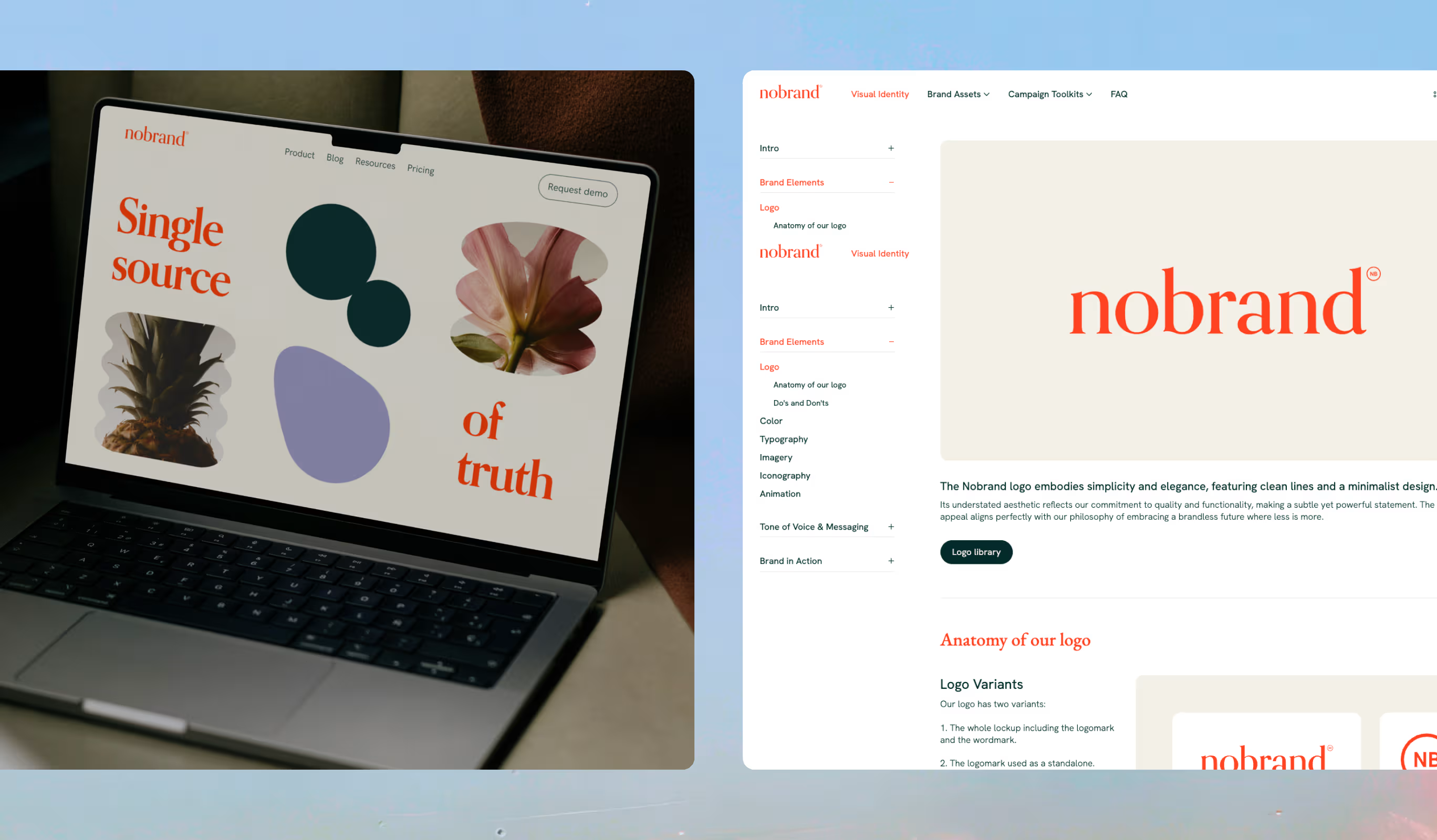
Imagine a regional manager needs to create a localized version of a sales brochure. But they don’t do this often and aren’t familiar with the brand. With static brand guidelines, they have to find the right version of the PDF, trawl through it, and interpret the guidance as best they can.
With a dynamic brand portal like Frontify, they simply go online, type a question into the AI-powered Brand assistant – in their own language – and receive tailored, translated guidance in return.
But this guide is about making your brand guidelines accessible to AI, not just humans, so what is the benefit for that use case?
A central brand portal makes it easier for external AI to access your brand guidelines. Instead of requiring a PDF to be pasted into prompts, the AI can access guidelines directly, through your tech stack. This removes a key source of inconsistency in AI content creation – variable inputs.
With AI, the quality and consistency of output relies on the quality and consistency of the input – a dynamic brand portal assures both.
Mistakes to avoid 💡
Uploading a PDF or a markdown (.md) file and calling it AI-ready. Both can become outdated, duplicated, or disconnected from current assets and rules. What’s needed is a living brand system.
3. Structure brand voice for AI
Whether your tone is professional, playful, authoritative, or authentic, readers know when it doesn’t feel right. So it’s very important – when you can create copy in a click – to get the tone on-brand. However, this can be difficult. Without AI-ready tone of voice guidelines, generative content sounds generic as it’s based on patterns from its training.
To create AI-ready tone of voice guidelines, you need to replace vague descriptions with structured writing rules. Woolly words are the common adjectives we all use to describe a brand. They’re not bad – they’re just descriptive rather than operational.
People can usually interpret these descriptive terms using their knowledge of company culture, past work, audience knowledge, and life experience. Since AI doesn’t necessarily have these things, it needs more explicit instructions.
This includes specifying preferred terminology, prohibited words or phrases, any formatting requirements, and sentence structures to ensure outputs sound authentic.
Examples of woolly words:
4. Build a terminology system
Written consistency isn’t just about the tone you use but also the words. Every brand has specific terminology that carries meaning for staff and customers, such as product names, descriptions, value props.
These decisions were no doubt hard-won – debated, voted on, vetoed, approved, amended, and finally agreed – and they should be used consistently throughout your work. Failure to do so could undermine conversion, brand recognition, or create compliance risk.
Here are some key categories to consider.
- Approved product names (exact spelling and casing)
- Preferred audience labels
- Category and value proposition language
- Legal or compliance-sensitive terms (required disclaimers, restricted claims)
- Words and phrases to avoid (with explicit alternatives where possible)
- Claims requiring substantiation (what must always be evidenced)
- Market-specific terminology (regional variations and allowed differences)
Think: if a specific term matters, it needs to be specified in your brand guidelines.
Mistakes to avoid 💡
Removing human judgment – Machine-readable guidelines improve consistency, but human creativity and review still matter, especially for high-value, high-risk, or emotionally sensitive work.
5. Define common content structures
Another way to help AI create compliant and consistent content first-time is to define common content structures. A LinkedIn post, a product description, and a campaign headline might all use the same tone of voice, but they have different structures, audiences, and expectations.
Reusable content structures help solve this problem by defining the building blocks of common content types. Rather than starting from scratch each time, AI can follow established formats that reflect how your brand communicates across different channels.
For example, a LinkedIn post structure might define:
- The purpose of the post
- The intended audience
- The type of opening hook to use
- The ideal length
- The number of key points to include
- The type of call to action required
Similarly, a product description framework could define the order of information, the key messages to include, and any specific terminology.
6. Build an AI-ready visual identity
Visual identity is another area where AI needs explicit guidance.
People can look at a brand image and instinctively understand the choices behind it. They recognise the feeling created by a particular colour palette, lighting style, or photography approach. They can understand whether an image feels ‘authentic’ or ‘aspirational’.
AI doesn’t interpret visuals in the same way. Where a human can easily understand how to create a ‘warm and friendly’ visual tone, for example, AI needs that described through saturation, density, and contrast.
Similarly, while a human designer can judge logo placement, sizing, and margins by eye, an AI tool needs specific ratios to observe. Here is some visual guidance to include in your AI-ready brand guidelines.
- Approved brand palette (hex/RGB values)
- Usage rules (primary vs secondary vs accent usage)
- Approved font families
- Hierarchy rules (H1, H2, body, captions)
- Minimum/maximum font sizes
- Line spacing and alignment rules
- Safe margins and padding constraints
- Approved illustration or photography styles
- Icon style rules (outline vs filled, stroke weight consistency)
- Visual tone definitions (saturation, contrast, etc)
7. Help people write better prompts
Until fully autonomous AI arrives, most AI tools will continue to be prompted by people. So – even when you’ve made your brand guidelines AI-friendly – people will be the connective layer. Their prompting skill will determine output quality.
The problem is, people prompt like they’re prompting other people. They need to learn to prompt for machines. So include examples of effective prompting in your guidelines. Using a structured format for asset creation can ensure prompts cover all the requisite elements first time.
Effective prompt for written content
From
Communicate like a thoughtful, research-driven collaborator. Prioritize precision and simplicity. Avoid cliches and jargon.
To
Audience: Executive leaders
Tone: Measured, concise, credible
Reading level: Higher education
Terminology: Use ‘consultant’; avoid ‘customers.’
Forbidden terms: ‘Cutting-edge,’ ‘disruptive,’ ‘best-in-class.’
Structure: Title: maximum 7 words; sentence length maximum 18 words; key points: 2–4 bullets, each under 16 words
Effective prompt for visual content
From
Create a social media graphic of a financial advisor and customer. Express approachability, confidence, and empathy through authentic human interaction.
To
Subjects: Two people, a financial advisor and a customer
Activity: Reviewing financial plans
Setting: Contemporary workspace, tablet visible; minimal interior styling
Color: Muted tones. Saturation low to medium. Typography HEX #1B4965, #62B6CB.
Aesthetic: Polished, naturalistic
Layout: Asymmetrical framing with negative space on the left for copy
Avoid: Extravagant décor, formal business attire, exaggerated poses.
As AI becomes more advanced and agentic, individual prompting will become less central to the process. The long-term goal is not to create a world where every employee becomes an expert prompt writer. It is to create workflows where AI can access the right context automatically and produce outputs within a governed system.
8. Keep brand guidelines and digital assets together
Brand guidelines and brand assets are like blueprints and building blocks. People and AI agents need both to create on-brand content. It always makes sense for them to be in the same place. But the rise of AI workflows means it’s now essential. In step 2, we advocated for a living brand system instead of a static PDFs or markdown file. This is why – creating a connected ecosystem.
Let’s look at people first. Imagine you’re building a campaign. When everything is disconnected, you might access brand guidelines in one place, search for digital assets in another, generate copy in AI, then open a design tool to create the visuals. It is clearly preferable to have brand guidelines, assets, and design templates within one system and workflow. Less complexity, less context switching, less cognitive load.
Now let’s consider AI agents acting on your behalf – autonomous AI you can prompt to complete end-to-end workflows. Such as ‘Create a LinkedIn campaign announcing our mid-year results’.
When digital assets, brand guidelines, templates, and tools are all part of the same system, AI can receive your prompt or goal, autonomously access brand guidelines, understand them, find relevant assets to create content (within permission levels), use templates to create a draft, and direct that artwork into a pre-defined approval workflow.
Two concepts are important here.
- Retrieval-Augmented Generation – or RAG for short – which means AI tools access specific brand context to generate content, rather than defaulting to their generic training. This makes output brand compliant by design
- Semantic understanding – The ability of agentic AI to understand how files and data relate to one another, and to the task at hand. The agent knows what guidelines, assets, templates, etc, are and can combine them correctly
To benefit from these advances, having your AI-readable brand guidelines accessible at the point of execution is key. It creates a system where AI can take more of the strain, generating on-brand content within a governed system.
At Frontify, we call this brand infrastructure. Read more about it here.
Mistakes to avoid 💡
Separating digital assets from guidance – AI needs the rules and the tools to create your content in one place.
9. Enrich digital assets with metadata
For AI tools to start creating content, they need to be able to find the right assets and understand whether, where, and how they can be used. This requires more than just a file name. It needs metadata.
Metadata is descriptive information attached to an asset that helps make it more discoverable and provides important context about its use. It tells AI what an asset contains, where it is relevant, and any rules or restrictions around using it.
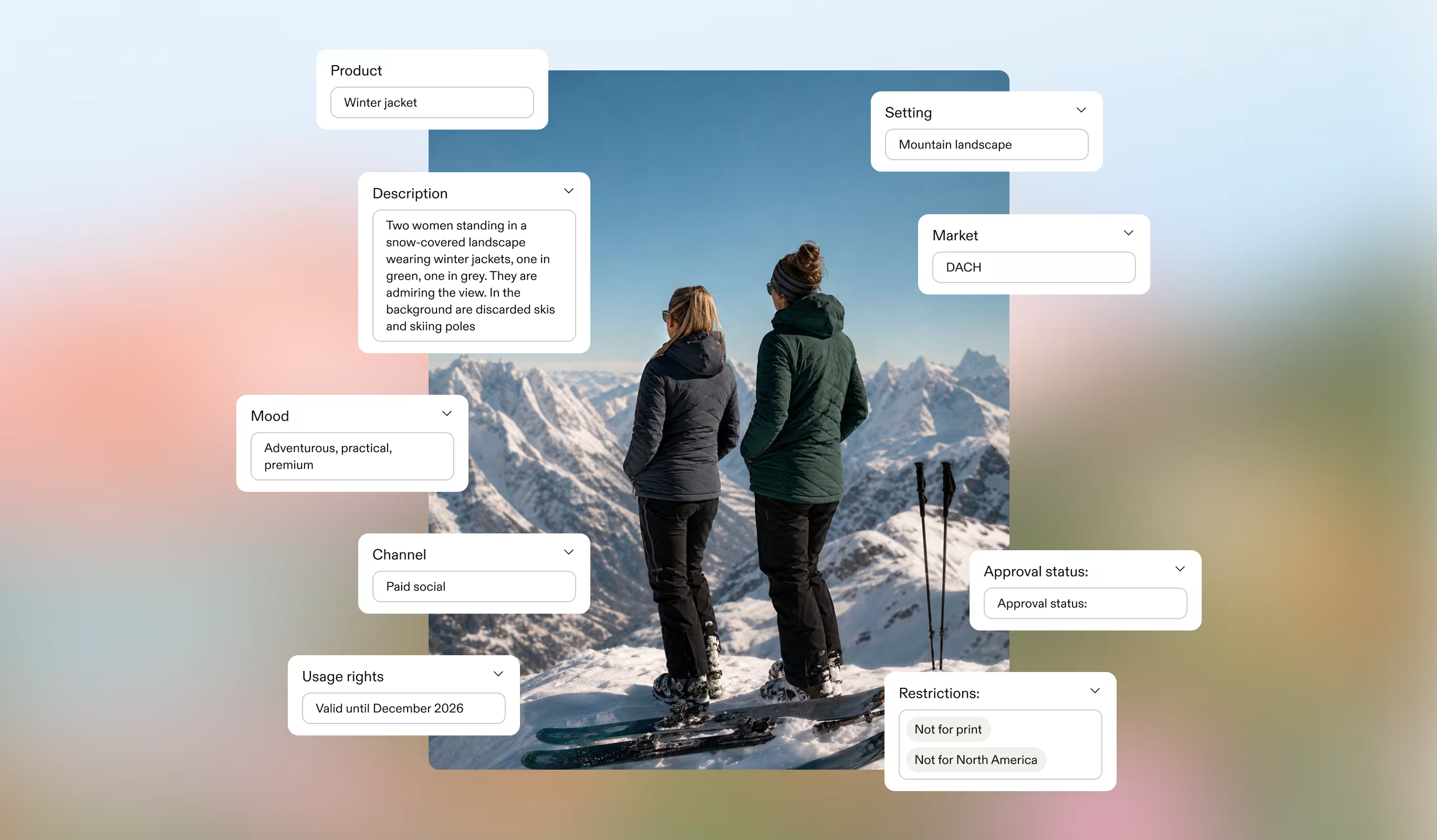
For example:
- Product: Winter jacket
- Description: Two women standing in a snow-covered landscape wearing winter jackets, one in green, one in grey. They are admiring the view. In the background are discarded skis and skiing poles
- Market: DACH
- Channel: Paid social
- Usage rights: Valid until December 2026
- Setting: Mountain landscape
- Mood: Adventurous, practical, premium
- Approval status: Approved
- Restrictions: Not for print, not for North America
With potentially millions of digital assets, the idea of manually adding metadata to every file might feel overwhelming. However, this is also an area where AI can help.
Tools like Frontify’s DAM Agent use visual processing and agentic AI to automatically identify and add relevant metadata, helping teams enrich their assets without relying entirely on manual input.
10. Connect AI tools to your system via MCP
Finally, we need to talk about connectivity. By now, you have:
- Enhanced your brand guidelines to be AI-readable
- Upgraded from static PDFs to a dynamic brand system
- Chosen a system that co-locates your brand guidance and digital assets
- Begun using the built-in AI functionality to make workflows faster, easier, and more accurate
The very last piece of the puzzle is connecting your external AI tools to your single source of truth. And you don’t want to build custom connections for every one. That adds overhead, complexity, and risk.
This is where MCP is invaluable. MCP is Model Context Protocol. It’s basically a universal adapter for AI tools that lets them plug directly into other platforms. Frontify has MCP built-in, so you can securely and easily connect tools like Claude, ChatGPT, Figma, Cursor or others to your brand platform.
Learn more about how MCP makes your brand intelligence AI-readable
You’ve made it
AI tools now have everything they need to operate as part of your governed brand production system, not outside it. They can read your brand guidelines, access approved assets, and use them compliantly to create on-brand content.
We know this process may sound complex, but we’re here to help you every step of the way – from converting your static brand PDFs into a dynamic brand system, to setting up Frontify as your centralized source of truth.