
The corporate guidelines say the brand is bold. The product team wants a more reassuring tone for a security launch. Legal requires a qualifier before a claim can run in Germany. The file storage contains six plausible hero images, but three are not cleared for this campaign.
Every fact can be valid, yet the right answer depends on the relationship between them. A person may resolve that context through experience, Slack messages, and approvals. An AI assistant or agent cannot reliably do the same when it receives only a folder of assets and a list of rules.
That is the central argument of this guide: brand consistency is not mainly a vocabulary problem; it is a relationship problem. A brand ontology makes those relationships explicit so people and systems can determine which guidance applies, which source is current, and which rule takes priority.
What is a brand ontology?
A brand ontology defines the kinds of things that exist in a brand system and how they can relate. It might say that a product belongs to a sub-brand, a claim applies only in certain markets, an image has channel-specific usage rights, and a regional legal rule overrides a global default.
In philosophy, ontology is the study of what exists. In data and AI work, the word has a practical meaning: a shared model of a domain's concepts and relationships. Some brand strategists also use "brand ontology" to describe a brand's essence or way of being. That is a legitimate but different use. This article focuses on operational brand knowledge - not philosophy, brand-essence exercises, or Ontology, the blockchain network associated with the ONT token.
There is no required technical format. A useful brand ontology can begin as connected records in a guidelines platform or DAM, a structured content model, or a simple database. More formal implementations may use a graph database or ontology standards. The test is not the software. The test is whether concepts, relationships, applicability, precedence, and provenance are explicit enough to support consistent decisions.
What a structured brand record looks like
Here is an illustrative record for one claim used throughout this guide. The exact field names are optional; the important part is that each decision-critical fact has a defined place.
Brand ontology vs. taxonomy, knowledge graph, and brand guidelines
These terms describe different layers of brand knowledge. They are not competing options. The clearest way to distinguish them is to carry the same object - Northstar Secure's launch image - through every layer.
The taxonomy helps someone find the image. The ontology defines which relationships and constraints can exist. The knowledge graph stores the current facts. The guidelines explain the decision to a person. A mature system connects all four instead of forcing one layer to do every job.
Related concepts fit into the same stack:
- Design tokens encode reusable design values such as color, spacing, and typography. They can populate a narrow part of a brand model but do not represent market rules, claims, rights, or approvals.
- DAM metadata describes specific assets. Well-governed metadata can populate the asset layer of an ontology or knowledge graph.
- Brand architecture defines the portfolio relationship among a master brand, sub-brands, products, and endorsed brands. Those relationships become part of the ontology, but the ontology also covers audiences, claims, assets, channels, rules, owners, and evidence.
- Machine-readable brand guidelines make guidance easier for systems to parse and retrieve. An ontology goes further by representing applicability, relationships, precedence, and governance across sources.
Why a brand ontology matters for AI and brand operations
Generative AI can retrieve the approved voice, current palette, and required legal language and still produce unusable work. The failure happens when the system cannot tell which sub-brand is speaking, which market the work is for, whether an asset is cleared for that channel, or which rule wins when guidance conflicts.
The problem grows with scale. One brand manager may carry the exceptions for a single product and market in their head. No team can do that reliably across dozens of products, regional requirements, agencies, claims, licenses, and approval paths.
What changes for AI systems
Structured brand knowledge can be delivered through retrieval-augmented generation (RAG), APIs, Model Context Protocol (MCP) servers, design systems, or simple context files - sometimes called a brand context file or brand.md. Autonomous agents can also retrieve this context while completing multi-step work. The delivery mechanism varies; the underlying requirement stays the same: the system needs the right facts and the logic that makes them applicable.
A brand ontology supports:
- More relevant retrieval. The system retrieves the facts for this product, market, channel, and audience instead of every item tagged with the brand name.
- Rule-aware generation and review. Hard constraints, defaults, and approved exceptions remain distinguishable instead of becoming an undifferentiated prompt.
- Traceable answers. High-risk recommendations can point back to the current guideline, approval, evidence, or rights record.
- Safer escalation. When evidence is missing or rules conflict, the system can abstain and route the decision to the right owner instead of guessing.
- Reusable corrections. A reviewer can connect a rejection to the missing relationship or rule so the same failure is less likely to recur.
What changes for brand operations
The same model reduces operational friction even when no generative AI is involved. It makes ownership visible, separates current and retired guidance, clarifies regional overrides, connects claims to evidence, and ties assets to rights and approvals. That means fewer routine questions to brand and legal teams, faster onboarding, more consistent self-service, and a clearer audit trail when something changes.
An ontology does not eliminate hallucinations or replace expert judgment. It improves the quality of the context available to a system and makes the decision path easier to inspect.
Internal brand knowledge is not the same as external AI visibility
An internal ontology can help employees and connected tools use the brand correctly. It does not automatically control how public AI assistants describe the company. External visibility also depends on authoritative public pages, consistent entity information, crawlable content, and appropriate web structured data. Schema.org markup can help describe public entities and content, but it does not replace the richer operational relationships a private brand model may need.
The five building blocks of a practical brand ontology
The model has five building blocks: entities, properties, relationships, rules, and provenance. These building blocks can be applied across brand domains such as strategy, products, audiences, markets, messaging, claims, visual assets, templates, roles, permissions, and workflows.
1. Entities and concepts
Entities are the distinct things the model describes: a brand, sub-brand, product, audience, market, channel, campaign, message, claim, asset, template, role, guideline, evidence item, or approval.
Give important entities stable identities. "The security product" is ambiguous; "Northstar Secure" is an entity that can be connected to claims, audiences, markets, assets, and owners.
2. Properties
Properties describe an entity: name, owner, status, region, effective date, expiration date, format, language, rights, or source. Without properties, an entity is only a label.
For Image 247, useful properties might include file type, rights expiration, approval status, photographer credit, and the source record. Properties should be typed consistently rather than buried in free-text notes.
3. Relationships
Relationships are where the model becomes useful. Common examples include belongs to, applies to, supports, depicts, inherits from, overrides, requires, is approved by, is evidence for, and must not be combined with.
Northstar Secure belongs to the corporate brand. The response-time claim applies to Northstar Secure. The German footnote is required by that claim in Germany. Image 247 depicts the product and is approved for digital launch channels. Legal approves the claim; brand approves the message and image.
4. Rules and constraints
Rules must be structured as decisions, not stored only as prose. A rule record should identify its type, scope, condition, result, priority, owner, source, and effective dates. That allows a system to compare rules instead of merely quoting them.
Useful rule types include:
- Hard constraints: legal requirements, prohibited names, rights restrictions, or mandatory disclosures.
- Contextual defaults: the normal choice for a product, market, audience, or channel unless a more specific rule applies.
- Soft guidance: preferred tone, layout, or imagery that can flex with a documented reason.
- Approved exceptions: a deliberate departure authorized for a defined campaign, asset, market, and time period.
Precedence must also be explicit. A practical order might be: legal and rights restrictions; market-specific hard requirements; valid, scoped exceptions where exceptions are permitted; product or sub-brand rules; global defaults; then soft guidance. An exception must never silently override a law, license, or non-waivable policy.
For the German launch email, the global default allows the approved claim. The market-specific hard rule adds a substantiation footnote. A campaign exception could change the headline tone if brand approved it, but it could not remove the legally required footnote.
5. Provenance and governance
Provenance records where a fact came from and why it should be trusted. Governance records who owns it, who approved it, when it takes effect, when it must be reviewed, and what happens if someone disputes it.
For the Northstar claim, the model should connect the approved wording to its evidence, legal decision, owner, effective date, review date, and source page. For Image 247, it should capture license terms, permitted channels and markets, expiration, approval status, and the person or system responsible for updates.
This is what separates a governed brand model from a folder of structured files. Structure makes information parseable; provenance makes it defensible and maintainable.
A practical example: A multi-market product launch
Consider a global software company launching Northstar Secure in the UK and Germany. Its decision context includes these connections:
- Northstar Secure belongs to the corporate brand and serves IT decision-makers.
- Its positioning prioritizes operational trust over speed or price.
- The response-time claim is supported by a named case study.
- The claim requires a substantiation footnote in Germany but not in the UK.
- Image 247 depicts the product and is cleared for digital campaign use.
- Brand approves the message and image; legal approves the German claim.
A marketer asks an AI tool to draft the German launch email. The same request produces very different results as the available brand context improves.
The point is not that an ontology writes better copy by itself. It gives the retrieval and generation system a decision-ready context. The five building blocks work as one chain: identify the entities, retrieve their properties, follow the relationships, apply rule precedence, and cite the governing sources.
How to build a brand ontology without overengineering it
Do not begin by modeling the entire organization. Begin with a small set of decisions the brand team already has to make repeatedly.
1. Start with competency questions
A competency question is a real question the model must answer, phrased as a user would ask it. Examples include:
- Which images are approved for a Northstar Secure launch email in Germany?
- Does the German guideline override the global claim guidance?
- Which evidence supports this claim, and when must it be reviewed?
- Who can approve an exception for this campaign?
Choose two or three questions that currently require a message to brand, legal, or a regional team. These questions define the first version's scope and later become its test set.
2. Inventory the sources of brand truth
List the systems and documents that contain relevant knowledge: strategy decks, online guidelines, PDFs, the DAM, design tokens, product data, campaign briefs, templates, approval records, legal repositories, and knowledge held by individuals.
Record an owner and status for every source. When two sources conflict, resolve the conflict; do not merge contradictory statements into a larger body of ambiguity.
3. Define a controlled vocabulary
Write agreed definitions for terms such as audience, market, claim, proof point, message pillar, approval, exception, retired, and approved. Include one positive example and, where useful, one non-example.
For instance, "approved" might mean legally cleared and ready to publish, or it might mean a manager informally liked a draft. A model cannot govern work until the organization distinguishes those states.
4. Model applicability and precedence
For each high-value rule, define what, when, and where it applies; who owns it; what it overrides; what overrides it; what evidence supports it; and who can approve an exception.
Start with the relationships required by the competency questions. If the pilot is about German launch emails, you do not yet need to model every event template or employer-brand asset.
5. Separate rules, examples, observations, and exceptions
Label every item according to what it actually represents. A hard rule is not a preferred example. A photo style used once is not automatically a universal requirement. An exception for one campaign is not a new default.
This distinction is especially important when AI extracts candidate knowledge from existing material. Extraction can accelerate the inventory, but human owners must confirm the type, scope, and authority of every consequential item.
6. Populate only what the first use case needs
Create the minimum set of entities, properties, relationships, and sources needed to answer the initial competency questions. One product, one or two markets, one channel, and a small set of high-risk claims or assets can be enough to prove value.
The first version is done enough to be useful when it can answer the chosen questions consistently, cite the current source, and escalate rather than guess when the answer is unsupported.
7. Test real work, fix the model, and assign ownership
Run a representative set of real requests through the model - twelve is a practical pilot sample - and have subject-matter owners evaluate the results. A sensible pilot gate is:
- 100% compliance with hard legal, rights, and approval rules.
- Correct product, market, audience, and channel applicability.
- A current source for every high-risk answer.
- Explicit escalation when evidence is missing or contradictory.
- At least 10 of 12 outputs accepted without a source or applicability correction.
When a result fails, classify the failure: missing entity, property, relationship, rule, precedence instruction, or source. Correct that part of the model and rerun the same test set. This turns feedback into governed knowledge instead of a one-time prompt edit.
Finally, assign one named owner to each major domain, establish a review cadence, and define a retirement path. Stable brand principles may need quarterly or scheduled review; legal restrictions, licenses, claims, and campaign approvals should be reviewed whenever their underlying authority changes.
A quick readiness check
Your organization is a strong candidate for a pilot if three or more of these statements are true:
- Teams regularly ask a person which guideline or asset applies.
- You manage multiple brands, products, markets, languages, or partner groups.
- Retired claims, templates, or assets continue to circulate.
- AI output sounds on-brand but is wrong for the product, market, or channel.
- Brand, legal, product, and regional sources contradict one another.
- Rights, approvals, evidence, or exceptions are difficult to trace.
How Frontify can operationalize structured brand knowledge
Frontify can serve as the governed environment where much of the knowledge an ontology describes is authored, maintained, retrieved, and connected to daily work.
- Entities and properties: Frontify Brand Guidelines and the Frontify DAM centralize guidelines, assets, templates, metadata, status, rights, and other brand information.
- Relationships and applicability: Guidelines structure, custom metadata, libraries, portals, targets, and permissions can represent practical connections among content, audiences, roles, regions, and use cases.
- Rules and governance: Permissions, approval workflows, versioning, and rights management help control who can access or release content and when an asset is no longer eligible for use.
- Provenance: Current guideline pages, source references, asset records, approval status, and history give people a path back to the governing information instead of an unsupported answer.
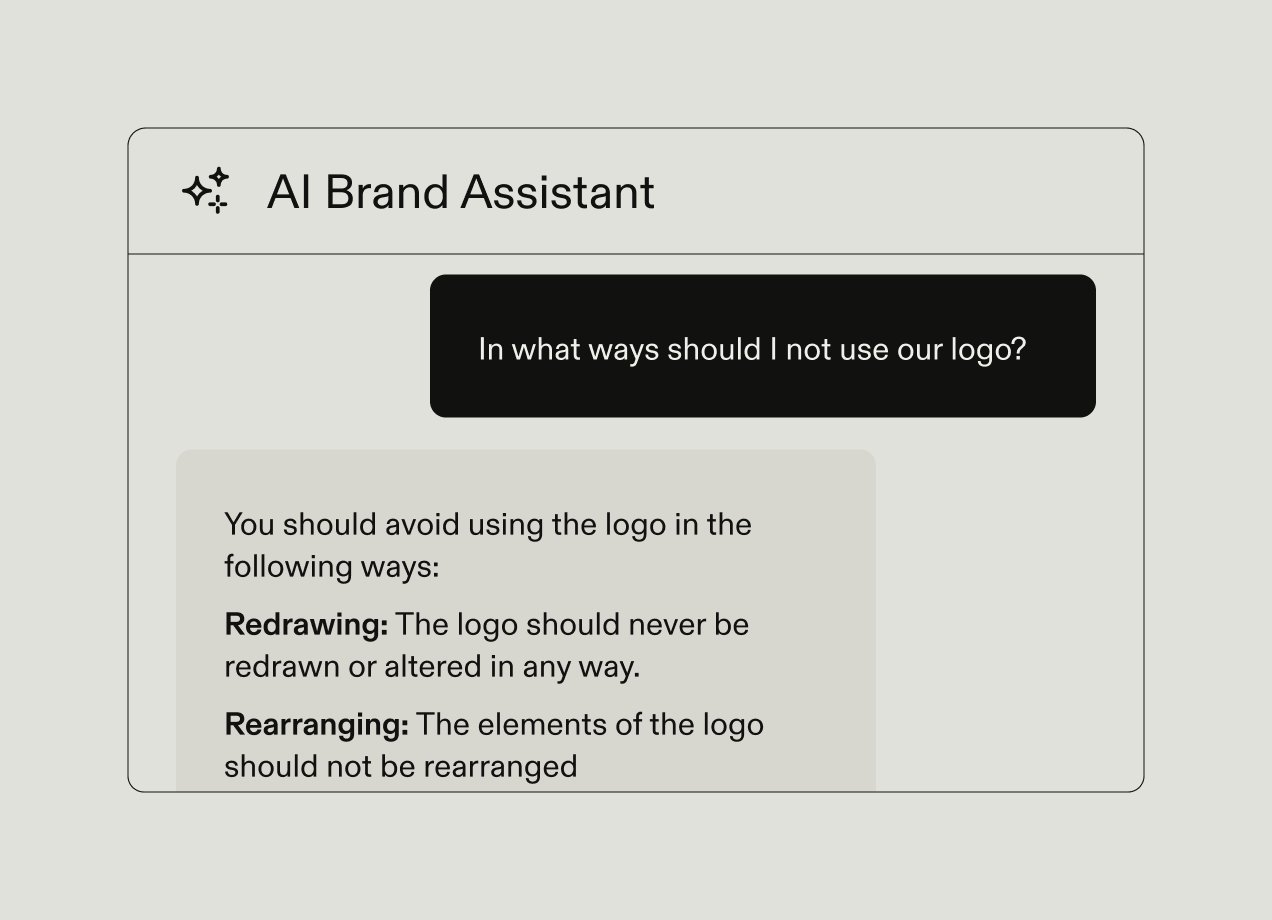
- Delivery to people and AI: Frontify's AI capabilities include a Brand Assistant that uses retrieval from accessible guideline content and links responses back to source material. The Frontify MCP server can make guidelines, assets, templates, and selected operational tools available to compatible AI systems. Frontify's APIs and webhooks support additional integrations.
The practical starting point is not a technology migration. Bring two or three competency questions to a working session, identify the sources and relationships required to answer them, and test whether your current brand environment can return a current, applicable, and traceable answer.