

Everything’s an agent these days (even when it’s not)
The word agent is everywhere right now. Every landing page. Every pitch deck. Seemingly every LinkedIn post. But much of what gets called an agent doesn't hold up once you look closely.
Let’s get clear on the basics straight away. An AI agent works toward a defined goal using methods that aren’t explicitly programmed. Like a human being, an AI agent can work around problems to achieve a specific outcome, meaning you can hand over tasks and receive near-finished work in return.
For example, imagine you’re launching a new skincare product. Instead of asking a generative AI tool to create the individual elements of your campaign, you can give an AI agent the goal of creating it all. ‘Plan and prepare the first month of the launch campaign’.
Connected to the right brand and product context, the agent could conduct research, create content, plan a launch calendar, and finally present the total outcome to you complete with its rationale.
This makes agentic AI very different from other AI tools, which rely on programming and set actions to deliver results. And this is where the confusion arises.

2026 has been the year of the agent
In the space of a few months, the leading AI labs all launched agentic technology.
- Anthropic introduced Claude Cowork in January
- Microsoft made Copilot Cowork available worldwide in June
- OpenAI launched ChatGPT Work in July
These tools are all delegation-style agents — essentially set-and-forget tools that work toward set goals and deliver finished work.
They’re intelligent and autonomous: planning tasks, accessing files, overcoming unexpected obstacles, and making decisions to achieve goals in the most efficient and effective way. (We’ll go into more detail below.)
This productivity promise has understandably intensified interest in agentic AI. But it has also led to the term AI agent being broadly adopted to describe any tool that uses AI to increase output and speed, including process automation, predictive analytics, and even chatbots.
While these tools are invaluable, this loose language artificially conflates traditional AI tools with the far more advanced concept of agentic AI.
Whether intentionally or otherwise, many vendors are describing their tools as having AI agents even when they don't actually meet the definition of agentic AI.
Agent-washing and the AI capability gap
Gartner, Forrester, and others have labeled this phenomenon agent-washing — the practice of rebranding existing AI capabilities as agentic AI to capitalize on the current trend.
Between misunderstanding, misappropriation, and overuse, terms like AI agent and agentic AI are becoming diluted almost as quickly as they’re spreading.
Forrester has observed that traditional process automation tools, standalone LLMs (large language models), and RAG (retrieval-augmented generation) systems “are being referred to as AI agents when they alone don’t possess the capabilities of planning, adapting, and actioning that agentic AI delivers.”
And, at the time of writing (July 2026), Gartner estimates only 130 of the thousands of vendors claiming agentic functionality actually offer something that deserves the title.
This wave of agent-washing risks organizations sinking time, money, and strategic focus into products that don’t actually deliver the desired autonomy they expect. As the veil lifts, instead of accelerating transformation, businesses find they’re back to square one, losing valuable momentum as they reevaluate and rebuild.

So, what actually makes something an agent?
The easiest way to understand agentic AI is that an AI agent is designed to achieve a goal — not just complete a task — and it has the flexibility to find its own way to do it, without explicit programming.
Here are examples of areas where AI agents can make an impact:
- Plan the best way to achieve a goal: Agents can work out what steps they need to take to plan the product launch described in the example above.
- Independently access, interpret, and apply information: Pulling attribution data from the CRM and ad platforms, then applying those insights to decide which channels deserve more spend, are some of the things agents can do.
- Use tools and collaborate with other systems: Agents can retrieve audience segments from the CDP, push them into the ad platform, and update the CRM once a campaign goes live.
- Reason, learn, and remember context: Agents can also recall that a client rejected a similar layout last quarter and flag a new, similar asset before it moves further in review
- Resolve challenges and adapt when things change: Another area where agents can support is noticing when an email is triggering high unsubscribe rates and pausing the remaining sends to adjust subject lines or segmentation before continuing the campaign.
Unlike other AI approaches, which are instructed to complete a single task, AI agents work toward a goal through an adaptive, multi-step process by reasoning, planning, and adjusting their approach to optimize outcomes.
“I think people hear ‘agent’ and picture something running off on its own, and that's not quite right. An agent can be given a huge amount of freedom, or almost none, depending on the permissions you set. Autonomy isn't baked into the technology itself but a dial we can choose to turn.”
Dominique Kunz, Group Product Manager
Categories of AI and how they differ
Forrester describes agentic AI alongside four other categories of AI. It's useful to see what each does well, even if in practice, the lines between them blur regularly.
"None of these categories exists in isolation. An agent will often rely on an LLM as the orchestrator and have techniques such as RAG built in. What separates agentic AI isn't the ingredients, it's whether the system can plan and adapt on its own."
Dominique Kunz, Group Product Manager
It’s the combination of autonomy, reasoning, and flexible execution that separates true AI agents from other AI capabilities.
Brand leaders caught in the messy middle
In our sector, brand and marketing leaders are trying to navigate this challenging market.
They’re being encouraged by the C-suite and tech vendors to use AI to “work smarter,” increase efficiencies, and scale production. They see comparator brands adopting tools and fear losing competitive advantage while observing team members adopting ad hoc AI tools to support day-to-day tasks (outside of governed workflows — oh no!).
The pressure to set direction and formalize AI workflows is high, but the path isn’t clear. Creative leaders are faced with hundreds of products that promise AI agents, but borrow the label without doing the work. In this context, the first challenge is working out which products are genuinely helpful and which are just hype.
For Frontify, it's a question of integrity. Calling something an agent when it’s not creates expectations that the technology can't meet. As brand and marketing experts, you (and we) know that isn't acceptable.
Frontify’s approach to agentic AI
Despite the pressure you might feel to implement agentic AI, it isn't a destination. It’s just the latest of a range of AI tools available to business leaders. And while it offers greater flexibility and autonomy than traditional AI approaches, that doesn't make it the right solution for every problem.
In brand management, consistency, predictability, and governance are often just as important as autonomy. That's why Frontify starts with the problem, not the technology. We choose the AI approach that delivers the best outcome for the task at hand.
“Agents aren't always the right tool. Output can vary more than with a straightforward automation, and running an agent is generally more expensive. The real skill is knowing where that flexibility is worth paying for, and where, as a human, you can already lay out a path that gets the machine to success reliably every time.”
Simona Barankova, AI Engineer
How we decide what AI to build
Knowing that agents aren’t always the right tool for the job, developing AI capability at Frontify always starts with a simple question: Does this task have a repeatable path or an open-ended goal?
If there's a defined and repeatable sequence of steps, we build a fixed workflow that follows the same steps every time, and may use AI to help with individual steps along the way, such as generating a description or applying a tag. These tools are designed to execute known processes efficiently and consistently.
If there's a goal to achieve — but the path isn't fixed — we consider agentic AI. These are problems that require planning, reasoning, adapting to new information, and deciding what to do next.
Our criteria for calling something an agent
When it’s appropriate to develop an agentic tool, it has to meet a high bar before we label it an AI agent.
- It must be able to handle novelty, rather than simply following predefined rules. That means responding appropriately to unexpected inputs, ambiguous requests, or changing circumstances.
- It must also be capable of adapting its approach. If one route fails, it should be able to try another. If a user provides feedback, it should be able to incorporate that feedback and adjust its behavior — not just repeat the same process.
How we make agents safe and understandable
Once we’ve decided to develop an AI agent, we scope it carefully to a specific context, purpose, operating boundaries, and permissions. This approach makes agents easier to govern, trust, and understand — what each agent can and can’t do, when to use it, and what the impact could be.
This is also what makes "autonomous" less alarming than it sounds. The fear is that an agent will act on its own and go somewhere no one intended. In practice, agents aren't given free rein, they're given responsibility within defined limits. Where the decision requires judgment or carries real risk, we build in confidence scoring, human oversight, and review, so a person stays in control.
Where appropriate, we also build confidence scoring, human oversight, and review into agentic workflows, so people remain in control when decisions require judgment or carry greater risk.
For more information on human-AI hybrid working in brand contexts, check out our Human-agent collaboration framework.
Agentic AI at Frontify (and the essential foundations to use it)
If there are two key takeaways from this article, they’re these: Not everything called an AI agent is an AI agent, and not every use case needs an AI agent.
That’s why Frontify offers a wide range of AI functionality, curated to brand and marketing needs and transparently labeled to help you use them with confidence. Our platform provides the foundational infrastructure, external connectivity, and built-in AI functionality brands need to harness artificial intelligence, including a growing suite of genuine AI agents, process automation, and predictive metadata.
Please note that, as AI capabilities evolve, so will our platform. For the latest information on AI within our product, visit our artificial intelligence page.
Frontify’s foundational infrastructure
A single source of brand truth
For AI to act on a brand's behalf, it requires more than access to a company’s logos or visuals. It requires access to the brand’s actual truth — its guidelines, approved assets, templates, and recent work — in a form both people and AI can understand. That's the piece much of the market hasn't built. But Frontify has.
By combining brand guidelines, DAM, and templates in one platform, Frontify gives AI tools a single source of truth to draw on when creating content or completing tasks. We call this brand infrastructure. It enables approaches such as retrieval-augmented generation (RAG) and improves the relevance and consistency of AI-generated outputs.
By providing this essential infrastructure, Frontify isn’t just a platform with AI built in. It’s the foundation AI-powered brand workflows are built on — giving every AI tool the trusted brand context it needs to create compliant content at scale.
Governed AI connectivity
Once Frontify is in place as your single source of truth, you can begin using our AI functionality (see below). However, you’ll also want to connect the external AI tools your teams already use. Frontify uses Model Context Protocol (MCP) to make this connection simple and secure.
Instead of requiring IT teams to build and maintain bespoke integrations for every new AI tool, MCP provides a standardized way for AI systems like Claude, ChatGPT, Cursor, and other MCP-compatible tools, to access approved brand context. That reduces technical overhead while maintaining governance through permissions and access controls — ensuring AI tools access only the right information for the right users in the right context.
Learn more about how Model Context Protocol supports AI-enabled brand operations.
Frontify's AI agents
Frontify includes genuine agentic AI for challenges where the goal is clear, but the path to achieving it isn't fixed. These agents plan, reason, and adapt within defined boundaries, so teams can hand off complex brand tasks and get finished work back.
Smarter asset management
An agent takes over the busywork of managing your asset library: reviewing asset metadata, understanding and applying what's missing, and organizing them into folders and collections. Hand it a batch of newly uploaded product photos, and it can analyze each one, then fill in the missing descriptions, keywords, and tags on its own, so your library stays organized and searchable without hours of manual tagging. (Early access)

Automated brand review
An agent reviews creative assets against your brand guidelines before they go out the door. Move a social graphic into review, and it checks the logo, colors, typography, and tone of voice against your guidelines, then flags anything off-brand with a clear explanation, right in the workflow, so reviews take minutes instead of hours. (Early access)
If you'd like early access to either of these capabilities, get in touch. We'd love to bring you in.

Brand assistant
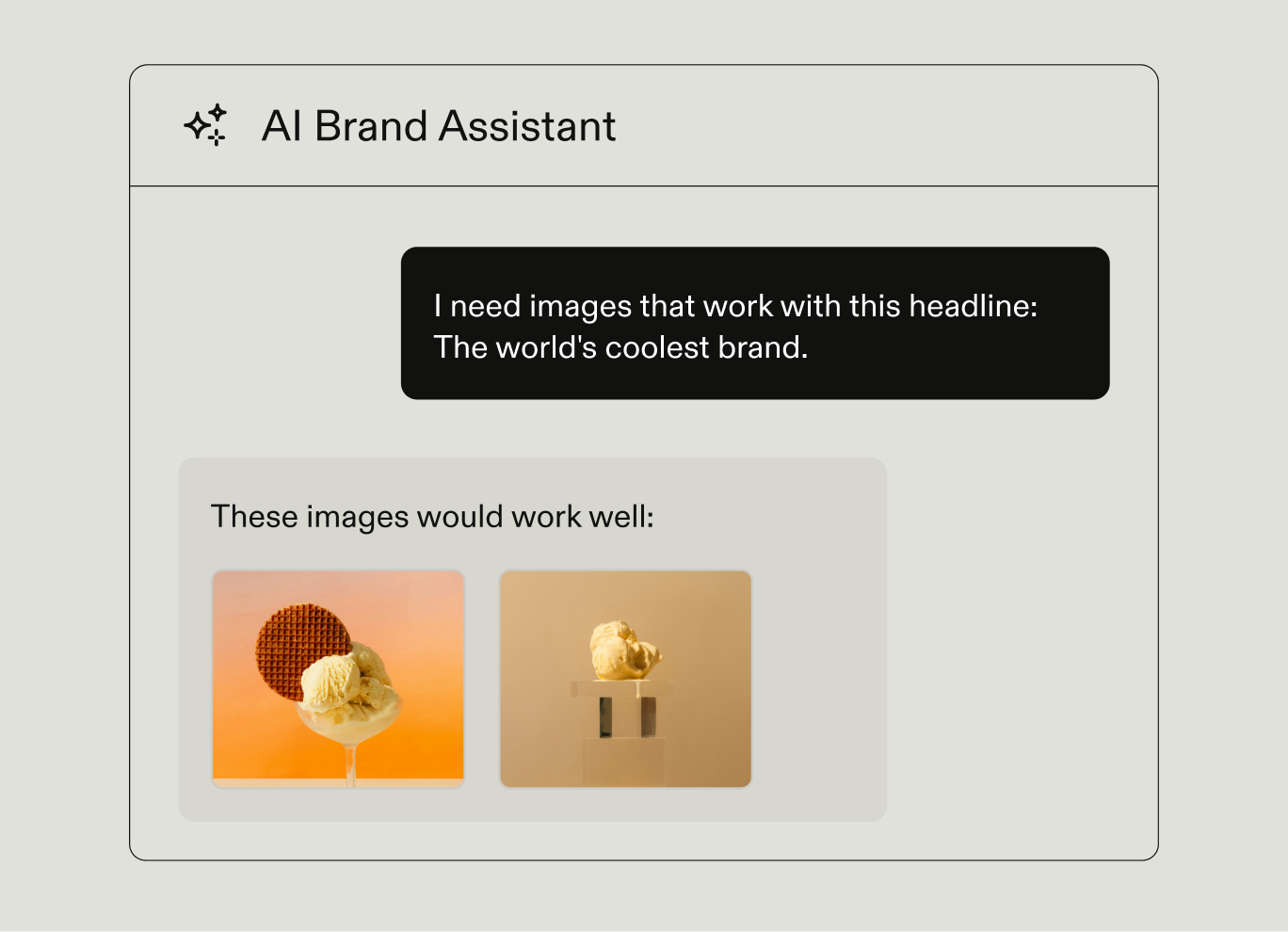
A conversational interface built into Frontify answers questions, generates copy, and finds assets, all grounded in your brand guidelines rather than generic training data. The brand assistant is available in over 100 languages. It reasons and retrieves well, but doesn't yet chain together multiple tools or steps on its own – which means it is not yet a true agent. As it takes on more tools and deeper multi-step reasoning over time, it will move further up that agentic scale.
Don’t let agent-washing derail your AI ambitions
Agentic AI may represent the next frontier for brands, but it isn't the whole story. And not every vendor claiming to offer AI agents is delivering the real thing. Don't let agent-washing distract you from what matters most: building the capabilities that will create lasting value for your business and brand needs.
To prepare your brand for the AI era:
- Understand how different AI technologies work — and stay skeptical of the hype.
- Identify where AI can create meaningful value across your brand and marketing operations.
- Align technology investments with your long-term strategic goals, not short-term trends.
- Build the foundations AI depends on: brand infrastructure, machine-readable guidelines, and workflows that combine human expertise with AI.
We hope this article has helped cut through the noise and clarify what matters most. If you'd like to explore how Frontify can help your brand implement AI, we'd love to talk.