

Aprimo is a combined digital asset management and content operations platform, built for companies that want campaign planning, workflow, and asset management running in one system. It gives teams a place to organize and find their digital files, plus features like:
- AI-powered automation
- Marketing calendars and project overviews
- A marketplace of integrations and partner apps
- AI-powered workflows and search functionality
- Enterprise-level security.
The combination of DAM and marketing operations in one platform is also what makes Aprimo the wrong fit for some teams. Do you actually need marketing operations features (like planning, calendars, budgeting, and resource management), or is your real challenge governing your brand (keeping assets and messaging across sub-brands, international markets, and internal departments)? Getting a clear picture of what you actually need from a DAM will help you work out which tools are a good fit for your business, and which have lots of great features that will never get used.
This guide covers six Aprimo alternatives, what each one is best for, and how each stacks up against Aprimo directly. Use it to compare different tools, and find one that matches the actual problem you're solving.
The best Aprimo alternatives at a glance
How to choose an Aprimo alternative
Aprimo is a combined DAM and content operations platform, built for large marketing organizations that need campaign planning, workflow, and digital asset management running in one system. It’s a popular choice for many companies, but it’s also two different products stitched together. This brings both benefits and drawbacks, depending on what your company actually needs.
The questions below help you understand whether Aprimo is a good fit for your company, and assess whether one of the alternative products mentioned would be a better option.
Are you buying marketing operations, brand governance, or both?
Aprimo bundles together two jobs that most vendors sell separately: campaign planning, calendars, budgeting, and resource management on one side, and asset governance and brand consistency on the other.
If your team needs the first set, you're shopping in a different category of tools than a team that needs assets kept on-brand everywhere they show up.
While Aprimo is a popular tool, some teams pair a focused DAM with a work management platform they already run, rather than looking for one product that does both jobs. That can cut platform complexity and speed up adoption, since neither tool is asking teams to learn functionality they don't need. But it also means two vendors, two logins, and an integration to maintain, so figure out whether you need the convenience of an all-in-one platform, or if two tools will be a better fit.
How much of the platform will you actually use?
A platform that offers lots of features will typically be more costly and complex than one with fewer features. If you’re going to use all the features, then it’s worth paying for. But if you only want half the functionality, there’s probably a better option for your company than a tool that does everything you can think of. Before you commit, map the feature set against what your team will realistically use in year one.
How well does the tool's AI understand your brand?
Most marketing and DAM tools these days say they’re “AI-powered”, but that means something different across each vendor. Some use AI for straightforward tasks like automatically tag files, while others build an AI layer grounded in your actual brand guidelines, so other tools can query them.
AI functionality can be a real differentiator between tools — one level just organizes files that are already in your library, while the other can answer brand questions and pass correct, on-brand assets to gen-AI tools like Claude and ChatGPT instead of making something up.
Multi-brand and multi-region governance
Check whether the tool enforces separate permissions, guidelines, and asset sets across brands and markets natively, or whether that structure has to be built on top after the fact. This is where enterprise DAMs diverge the most, and it's one of the hardest things to retrofit once a rollout is underway.
Implementation time and total cost
Enterprise DAM implementations range from a few weeks to well past a quarter, and setup fees, extra modules, and per-user pricing all add up quickly. Ask every vendor for a typical implementation timeline for companies of a similar scale and complexity as your organization. Get a fully loaded quote at your actual user count, including agencies and external partners, not just the internal team.
Best Aprimo alternatives for centralized brand management
1. Frontify - best for governing brand and content assets with AI
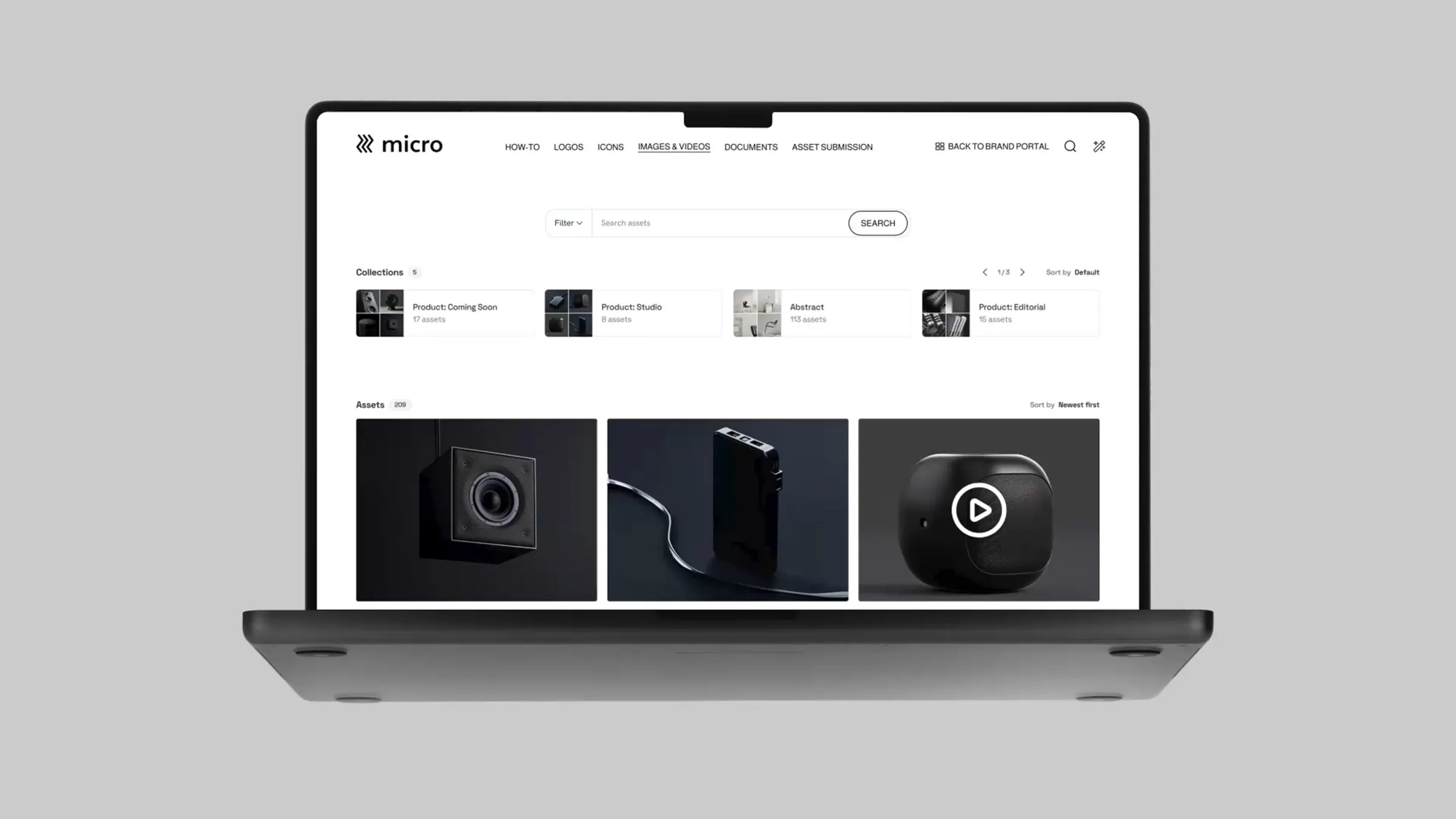
Frontify is an enterprise DAM at its core, wrapped in brand guidelines, templates, governance, and AI-powered brand intelligence. Its AI functionality is the clearest difference between it and everything else on this list. The Brand Assistant answers brand questions in natural language, sourced from a company's own guidelines, and links back to the exact section it pulled from, in over 100 languages. The Frontify MCP server extends that further, letting AI tools like Claude, ChatGPT, and Cursor use and reference a company's real assets and guidelines directly.
- Compared to Aprimo: Both consolidate multiple tools into one platform, but Aprimo consolidates around marketing operations while Frontify consolidates around the brand, connecting the DAM to guidelines, templates, and governance. Frontify typically gets organizations running in two to three weeks, absent content migration, a meaningfully shorter runway than a combined operations-and-DAM platform.
- Who it fits: Enterprise and global brand teams whose real problem is keeping assets and messaging consistent across brands, regions, and partners, not running campaign planning or budgeting from the same platform.
- Standout: The Brand Assistant and MCP server together, an AI layer grounded in a company's actual guidelines that can answer questions and hand real, on-brand assets to outside AI tools instead of guessing.
- Results from other companies: Spring Health cut template production time from three to six weeks down to about 10 minutes, saving the team 16+ hours per template. Nestlé runs dedicated sub-portals so its 2,000+ local and global brands can access only what's relevant to them. Lufthansa’s brand platform gets more than 40,000 page views every month, and has scaled to over 14,000 platform users.
- One consideration: Enterprise scope and pricing are best suited to brands managing assets and governance at real scale, not smaller teams with lighter needs.
2. Bynder - best for content operations
Bynder launched in 2013 as one of the first DAM platforms built purely as SaaS, rather than adapted from on-premise software. It's stayed DAM-first since, but its 2022 acquisition of GatherContent, a content operations platform, added collaborative editorial workflows on top of its DAM, extending the platform from managing finished assets to managing the content creation process as well.
- Compared to Aprimo: The two overlap heavily on content operations, but Bynder stays DAM-first while Aprimo's operations layer extends into campaign planning, calendars, and budgeting. That makes Bynder the better fit for teams that want Aprimo's operational depth around assets and content workflow, without the marketing-planning layer they may not need.
- Who it fits: Large marketing organizations juggling high content volume, complex approval chains, and distribution across many channels.
- Standout: Established enterprise DAM with deep workflow and distribution tooling.
- One consideration: Implementation can run past three months, especially with a large existing library.
See how Bynder compares to other DAM tools.
3. Adobe AEM - best for teams committed to the Adobe ecosystem
Adobe Experience Manager (AEM) is a combined DAM and content management system. It’s part of Adobe Experience Cloud, with native connections with other Adobe tools like Firefly for generative AI image editing, and Creative Cloud so designers can bring assets in and out without leaving their creative tools. For organizations that are heavy users of Adobe for creative and marketing operations, that connection is a real benefit.
- Compared to Aprimo: AEM trades Aprimo's marketing operations layer (planning, calendars, budgeting) for web content management, so it consolidates a different pair of tools entirely. Teams already running Adobe Creative Cloud will likely prefer Adobe AEM over Aprimo thanks to its tight integrations.
- Who it fits: Enterprises already committed to Adobe.
- Standout: Content and asset management together inside Adobe Experience Cloud.
- One consideration: Significant complexity and cost, and it typically needs technical resource to run.
See how Adobe AEM compares to other DAM tools.
4. Acquia DAM - best for teams building on Acquia or Drupal
Acquia DAM is digital asset management software formerly known as Widen, renamed after Acquia acquired the company in 2021. It's sold both as a standalone product and as part of the broader Acquia Digital Experience Platform (DXP), which also includes the Drupal CMS. While you can use it successfully on its own, its deepest ties are to the rest of the Acquia stack.
- Compared to Aprimo: It's narrower in scope and carries no operations layer, so it suits teams that want asset management tied to their web platform rather than to campaign planning and budgeting. Where Aprimo positions itself as a single platform for marketing operations, Acquia DAM positions itself as one piece of a connected content and commerce stack.
- Who it fits: Organizations already building on Acquia or Drupal, where the DAM plugs directly into the same platform serving their website.
- Standout: Tight CMS integration, shared user management, and unified reporting across the Acquia Digital Experience Platform.
- One consideration: Much of the value depends on being inside the Acquia ecosystem — standalone buyers get a solid DAM but lose the connectivity that brings the biggest benefits.
See how Acquia DAM compares to other DAM tools.
5. Brandfolder - best for teams already using Smartsheet
Brandfolder has a reputation as a straightforward, well-liked DAM. It was acquired by Smartsheet, an enterprise work management platform, in 2020. Smartsheet has kept investing in it since, adding creative automation and design templating capabilities in 2022 with its acquisition of Outfit. The native tie into Smartsheet's work management platform is now the product's core differentiator.
- Compared to Aprimo: The Smartsheet pairing covers some of the same project and workflow ground Aprimo bundles into one platform, but through two connected products rather than a single one. Teams get Aprimo-style operational management without buying a combined DAM-and-operations platform outright.
- Who it fits: Marketing teams that already run Smartsheet for work management.
- Standout: Creative automation and templating (via the Outfit acquisition) built directly into the DAM, letting teams generate on-brand variants of an asset without a separate design tool.
- One consideration: The most value comes from the Smartsheet connection, so standalone buyers miss out on some of its strongest features.
See how Brandfolder compares to other DAM tools.
6. Canto - best for asset library with product and commerce content
Canto has been in the DAM market for more than three decades, building a reputation as a straightforward, searchable asset library. Two recent acquisitions show where it's headed next: MerlinOne in 2023 brought in AI-powered visual search, and Image Relay in September 2024 added product information management (PIM) directly into the platform. The result is a DAM that's increasingly aimed at retail, manufacturing, and CPG teams that need product data (like specifications, pricing, and SKUs) managed alongside product imagery, not just brand assets.
- Compared to Aprimo: Canto is a focused asset library rather than an operations platform, and its most recent investment (PIM via Image Relay) points toward product content rather than the campaign planning and budgeting Aprimo bundles in.
- Who it fits: Organizations with large photo and video libraries, especially retail, manufacturing, and CPG brands where product content and asset management need to work together.
- Standout: Now combining DAM with product information management after the Image Relay acquisition.
- One consideration: Brand governance depth is lighter than the brand-led options on this list, since Canto's recent product direction has leaned toward product content over guidelines and governance.
See how Canto compares to other DAM tools.
Choose the Best DAM for your business
When you're looking for a DAM platform, most companies are really trying to solve one of a couple of different core challenges. Some have a marketing operations challenge, where they need to plan campaigns, manage budgets, and coordinate the many moving pieces that go into producing and launching content. Others have a brand governance challenge, where the real problem is keeping assets, guidelines, and messaging consistent everywhere the brand shows up, across teams, regions, and partners.
Aprimo is a good choice for companies solving that first challenge. But if your actual problem is managing your brand across regions and partners, you need a DAM built around the brand rather than operations. This becomes clear at several key moments for your business:
- A rebrand. Rolling out new brand materials, retiring the rest, and keeping the entire company on-message. KIA ran its 2021 rebrand on Frontify, giving every employee access to the new brand's assets and guidelines from day one.
- An acquisition. A new sub-brand needs to be brought into your brand ecosystem. You have new teams, new assets, and a new structure to manage.
- Onboarding new agencies or contractors. External partners need the right assets fast, without constantly emailing the internal brand team.
- Sub-brands drifting apart. The gap between what head office intends and what a regional or product team publishes gets wider without the right information, guidelines, and assets to keep everyone aligned.
Frontify is the enterprise DAM and brand intelligence platform for teams that need brand governance and AI that understands their brand. Find out how it can work for your business — book a demo today, or find out how you can switch to Frontify.
