Brandfolder, owned by Smartsheet, is a popular DAM built for asset organization, distribution, and reporting. Teams that live in Smartsheet for campaign and project work tend to like it, since Brandfolder's assets sync directly into the sheets, forms, and workflows they're already running.
But at its core, Brandfolder is a DAM, and DAM is table stakes now. If your team's problem is finding and sharing files, it solves that well. If your problem is keeping every asset on-brand, across regions, agencies, and now AI tools pulling files without a human checking first, that's a different job, and it calls for a different kind of platform.
This guide compares Brandfolder against eight alternatives, from focused asset libraries to enterprise DAMs built on brand guidelines, templates, and AI-powered brand intelligence, so you can figure out which type of tool your team actually needs.
The best Brandfolder alternatives at a glance
This guide is maintained by Frontify, which is included among the alternatives below. Every tool in this list was assessed against the same criteria.
How to choose a Brandfolder alternative
Brandfolder is a solid DAM. Owned by Smartsheet, it's built for asset organization, distribution, and reporting, and it works especially well for teams already running projects and workflows in Smartsheet. But when you’re comparing DAMs, you need to understand whether your team needs what Brandfolder offers, or if a different tool, built around a different job, would be a better option. Here’s what to look for and how to compare different tools against Brandfolder’s capabilities.
Pure asset library vs. connected brand platform
Some teams need a better place to store, organize, and distribute files. Others need those files connected to the guidelines, templates, and governance that help global teams use them correctly. A pure DAM solves the first problem well, but it won't solve the second on its own.
Brandfolder's core offering is an asset library, full-text search, tagging, and version control, with guidelines handled through a separate module rather than built into the asset library itself. When you’re comparing DAMs, start by figuring out which of these options you need, as that can eliminate half your options almost immediately.
Multi-brand and multi-region complexity
Managing one brand is entirely different than managing a portfolio of brands across a dozen markets. If you're in the second category, you’ll need a tool that can enforce separate permissions, guidelines, and asset sets per brand and region. Check whether the vendor you’re looking at offers that as a core feature, or whether that structure gets bolted on with custom configuration and extra cost.
Brandfolder handles this through Portals. Administrators build a branded, permissioned homepage per audience, region, or partner, which works well for external sharing but isn't the same as a native multi-brand architecture with separate schemas per brand.
Whether guidelines and templates live with the assets
In some DAMs, brand rules sit somewhere else entirely: a shared drive, a static PDF, a separate platform. In others, the rules are attached to the assets themselves, so someone who finds a logo also sees how and where they're allowed to use it. The tighter that connection, the less your brand team has to police afterward.
Brandfolder's Brandguide pulls colors and images from a connected Brandfolder or collection to build a guidelines microsite, but it's a distinct destination a user has to navigate to, not something surfaced on the asset page itself.
How well the tool's AI understands the brand
Most software you buy these days has some element of AI within it. In DAMs, "AI-powered" covers a wide range of functionality, from auto-tagging photos to an AI layer that actually knows your brand's rules and can answer questions about them. Brandfolder's Brand Intelligence engine auto-tags assets and powers natural-language queries inside Brandfolder's own search bar, which speeds up finding files but doesn't extend brand knowledge to tools outside the platform.
The distinction matters more now that people are pulling assets into Claude, ChatGPT, and other tools outside the DAM entirely. Ask whether the AI just labels files, or whether it can hand another tool a correct, on-brand asset without a human checking first.
Ecosystem fit and switching cost
Some DAMs deliver most of their value only inside a larger ecosystem, like Brandfolder inside Smartsheet or Acquia DAM inside Drupal. Since Smartsheet acquired Brandfolder in 2020, the two have built native, bidirectional integration: Brandfolder assets sync into Smartsheet, and intake forms embedded in Brandfolder can trigger Smartsheet workflows automatically.
If you're already running work management in Smartsheet, that connection is a real benefit. If you're not, you're paying for integration you won't use. Either way, get a straight answer on what migrating your assets, metadata, and permissions out of your current tool would take before you sign anything.
The best Brandfolder alternatives for digital asset management
Whether you’re unhappy with Brandfolder as your DAM provider, or you’re looking for new digital asset management software and weighing up options, here are eight alternative providers to consider.
1. Frontify
Frontify is an enterprise DAM at its core, wrapped in brand guidelines, templates, governance, and AI-powered brand intelligence.
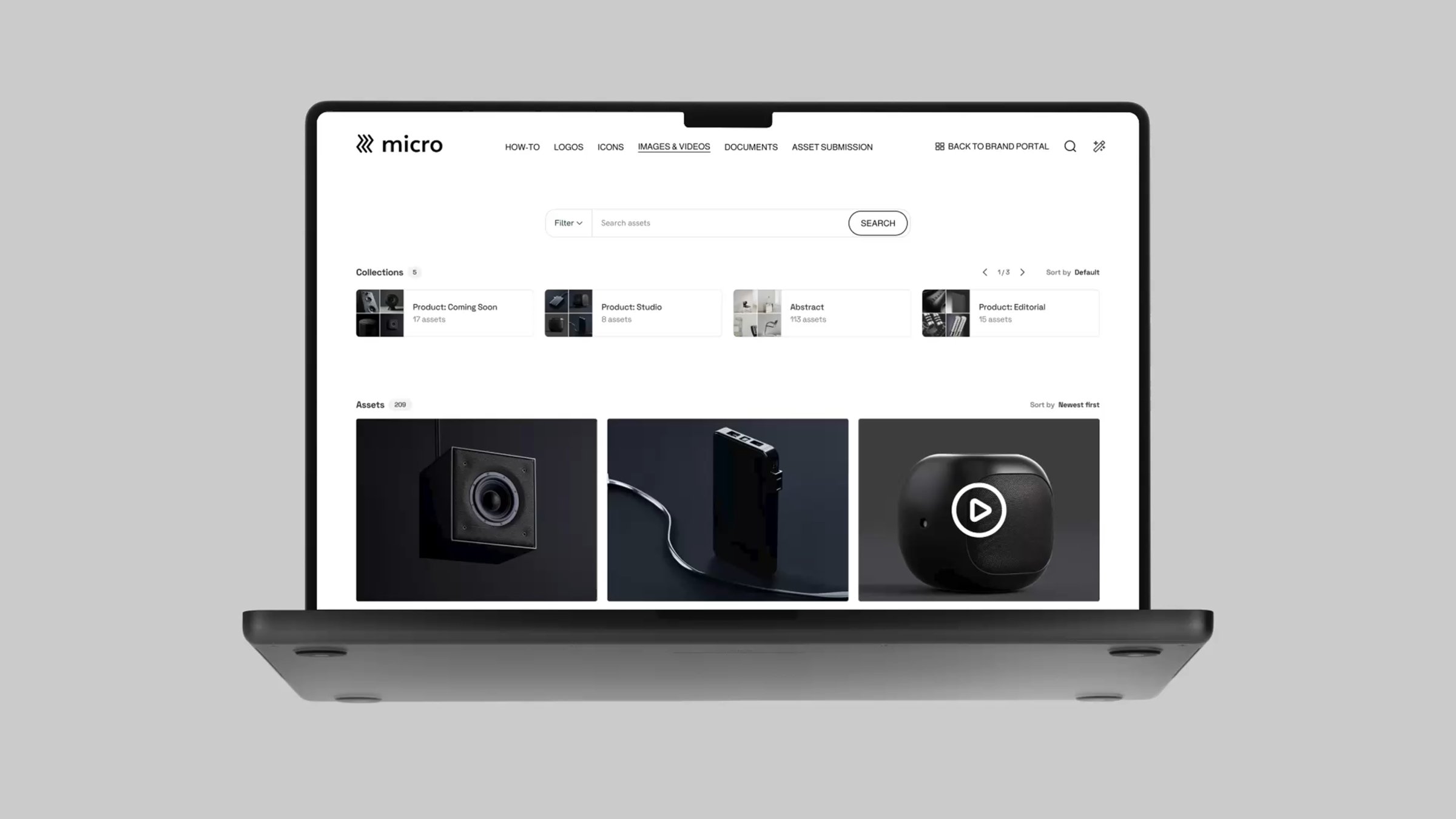
AI that knows the brand, not just the files. Frontify's MCP server connects AI tools like Claude, ChatGPT, and Cursor directly to a team's brand assets, guidelines, and templates. A team member or AI agent working in any of those tools can pull the correct logo file, check a tone-of-voice rule, or retrieve an approved template without someone copying and pasting context by hand.
The AI Brand Assistant does the same job for people: it answers brand questions directly from your guidelines, in more than 100 languages, and links back to the exact section it pulled from so the answer can be checked. Both draw from the same brand intelligence layer, a governed source of brand context that other tools and AI agents can query directly and easily.
A genuine enterprise DAM underneath it. That AI layer sits on top of substantial DAM functionality:
- Granular permissions, plus rights and expiry alerts that flag licenses before they lapse
- Lifecycle automation that moves files through review, approval, and archiving without manual tracking
- Real-time media optimization, transformation, and delivery through the media engine, developer API, and CDN
- CDN-based embedding, so an asset updated once updates everywhere it's linked
- Interactive guidelines, structured approval workflows, and multi-brand, multi-region governance
- Locked, self-service templates, with a Creative API for teams generating content programmatically at scale
- Native integrations with Adobe Creative Cloud, Figma, Sketch, InDesign, Salesforce, and common CMS platforms
Results teams can point to. At Spring Health, template production dropped from three to six weeks under their old system to about 10 minutes, saving the team more than 16 hours per template. Lufthansa’s brand platform gets more than 40,000 page views every month, and has scaled to over 14,000 platform users. Alfa Laval, previously running brand guidelines as a static PDF, reached 3,500 active users and 80,000 asset downloads in its first eight months on Frontify.
See a full breakdown of how Frontify compares to Brandfolder.
One honest consideration. A team that only needs to store and share a small asset library, without the governance or AI layer, may find one of the more focused options below a better fit.
2. Bynder
Bynder is widely credited as one of the vendors that defined the modern, cloud-based DAM category. It now serves more than 4,000 organizations, including Spotify and Puma, with a platform built around three connected pieces: a central asset library, a highly configurable taxonomy to grow with your company, and workflow tools for briefing, reviewing, and approving content before it ships.
That workflow depth is the main draw for larger teams managing high volumes of campaign content through multiple approval stages, and Bynder has recently pushed further into agentic AI for enrichment and governance tasks. One potential tradeoff is the rollout: implementation typically involves more configuration than a simpler asset library, and getting workflows, permissions, and metadata schemas set up correctly usually requires dedicated onboarding time.
Best for: Broad content operations at scale.
Standout: Established enterprise DAM with deep content workflows.
One consideration: Configuration and onboarding overhead.
3. Acquia DAM (Widen)
Acquia DAM is the product formerly known as Widen, renamed after Acquia acquired the company in 2021. It's sold both as a standalone DAM and as part of the broader Acquia Digital Experience Platform (DXP), which also includes the Drupal CMS.
For a team already running Drupal or other Acquia products, that shared ecosystem means asset management, content delivery, and personalization can operate off the same underlying platform rather than being stitched together through integrations. Teams outside that ecosystem still get a capable standalone DAM, but the deeper value, tighter CMS integration, shared user management, and unified reporting across the DXP, is reserved for Acquia customers specifically.
Best for: Teams already on Acquia or Drupal.
Standout: DAM built into the Acquia Digital Experience Platform.
One consideration: Value concentrates inside the Acquia ecosystem.
4. Canto
Canto has been in the DAM market for more than three decades, building a reputation as a straightforward, searchable asset library. In September 2024, it acquired Image Relay, a company that had built its own platform unifying DAM with product information management (PIM).
The result is a DAM that's increasingly aimed at retail, manufacturing, and CPG teams that need product data (specs, pricing, SKUs) managed alongside product imagery, not just brand assets. That's a completely different roadmap than a platform built around brand governance: Canto's recent investment has gone into product content and commerce use cases rather than guidelines, templates, or an AI layer that understands brand rules.
Best for: Asset libraries with product and commerce content.
Standout: Established DAM now expanding into PIM and commerce.
One consideration: Roadmap points to product content over brand governance.
5. MediaValet
MediaValet is built exclusively on Microsoft Azure, a choice that shapes most of the platform’s core offering: unlimited users, availability across dozens of Azure data center regions, and AI features (search, tagging, face recognition) drawn from Azure's Computer Vision services. For an organization that’s already heavily using Microsoft infrastructure, that alignment simplifies the procurement process and security review considerably, which can be a deciding factor for companies that want to shorten the procurement and implementation timeline.
Its core strength is straightforward, high-volume storage and distribution rather than a connected guidelines or template layer. Brand governance and AI-driven brand context tend to sit outside the platform rather than built into it.
Best for: Scalable cloud asset libraries.
Standout: Azure-built DAM focused on scalable storage and distribution.
One consideration: Centers on storage over a connected brand and AI layer.
6. Adobe Experience Manager Assets
Adobe Experience Manager (AEM) Assets is the DAM module that’s part of Adobe Experience Manager, Adobe's broader digital experience platform. It plugs directly into Adobe Firefly for generative AI image editing and into Creative Cloud apps like Photoshop and Illustrator so designers can bring assets in and out without leaving their creative tools.
For organizations that have already committed to Adobe for creative and marketing operations, that native connection is the appeal. You have one login, one set of assets, and one workflow spanning creation, DAM, and delivery. But for companies working outside of the Adobe stack, that integration depth becomes the cost of entry, since AEM Assets is priced and positioned as part of the Adobe suite rather than a standalone tool.
Best for: Enterprises already standardized on Adobe.
Standout: Enterprise DAM built into the Adobe Experience Manager platform.
One consideration: Value depends on committing to the wider Adobe stack.
7. Cloudinary
Cloudinary is an API-first platform built for developers, not brand teams. It serves several million developers and more than 10,000 brands including Adidas and M&S.
Its core strength is programmatic media transformation: resizing, cropping, format conversion, and AI-powered editing like generative fill or background removal, all triggered through API calls or transformation URLs rather than a visual interface. Unlike traditional DAMs like Brandfolder, Cloudinary goes deeper on developer transformation and tooling for teams building media-heavy products.
Cloudinary goes deeper on developer transformation and tooling for teams building media-heavy products. That's its core. Frontify supports real-time media optimization and delivery through its media engine, developer API, and CDN, and its primary job is managing assets and keeping the brand consistent.
Best for: Developer teams building media-heavy products.
Standout: Deep media transformation and delivery tooling for developers.
One consideration: Built around developer workflows rather than brand governance.
8. Papirfly
Papirfly is built around a different starting point than most DAMs on this list: instead of leading with storage, it leads with content production. The platform combines a DAM with templates for content creation, locking brand-critical elements (logos, colors, fonts) into templates while leaving other fields open, so regional and frontline teams can localize campaign materials without design skills or the risk of going off-brand. Built-in approval workflows route each output through review before it ships.
That focus on templated production is also its limitation: Papirfly's investment has gone into content creation and governance-at-the-point-of-creation rather than an AI layer that connects brand context to outside tools like Claude or ChatGPT.
Best for: Enforcing brand rules at the point of content creation.
Standout: Template-driven production with brand rules built into the workflow.
One consideration: Centers on template production over an AI-connected brand layer.
Choose the right DAM for your business
When you’re comparing different DAM products, your decision comes down to one key question: are you looking for a better place to store and organize files, or are you looking for a system that keeps those files on-brand once they leave the library?
If it's the first, a focused DAM does the job well. Bynder, Acquia DAM, MediaValet, and Cloudinary are all strong at organizing, securing, and distributing assets at scale, and each is worth evaluating on its own terms depending on your existing tech stack.
If it's the second, you need more than storage. You need guidelines, templates, and governance connected to the assets themselves, plus an AI layer that actually understands your brand. That's what Frontify is built for: an enterprise DAM together with brand guidelines, templates, governance, and AI-powered brand intelligence, running alongside the creative and martech tools your team already uses.
Already running Brandfolder and considering the move? See how switching to Frontify works. Alternatively, book a demo to see how Frontify can work for your team.