

Any collaboration should start with clarifying expectations and determining the type of cooperation each task actually needs. This is also true when working with agents, especially for work that relies on human judgment — such as brand work.
With more touchpoints, tools, and audiences for brands than ever before, the pressure for productivity and velocity keeps rising. With AI agents everywhere, translating that pressure into automation looks like the obvious solution.
But for brand work, automation is the wrong frame.
Brand is judgment, taste, context, and culture. It's the work of making sure a company shows up the same way across a thousand decisions made by people who have never met. An automated one-size-fits-all approach would produce the opposite of what a brand needs: indifference instead of emotion, noise instead of engagement, drift instead of loyalty.
Great brand leaders aren’t choosing between embracing AI or resisting it. They're deliberate about how they use and collaborate with AI, depending on the task. The useful question, therefore, is not how much we can automate, but what kind of collaboration each task requires.
Four modes of collaboration
At Frontify, we’ve developed the Human-Agent Collaboration Framework to guide our discussions on how AI agents should act to support brand work. The model's two axes map the modes of collaboration brand practitioners expect and find most useful.
The first axis describes the work itself: defined and rule-based on one end, open and exploratory on the other. The second axis describes where the call lives: with established rules or with human judgment.
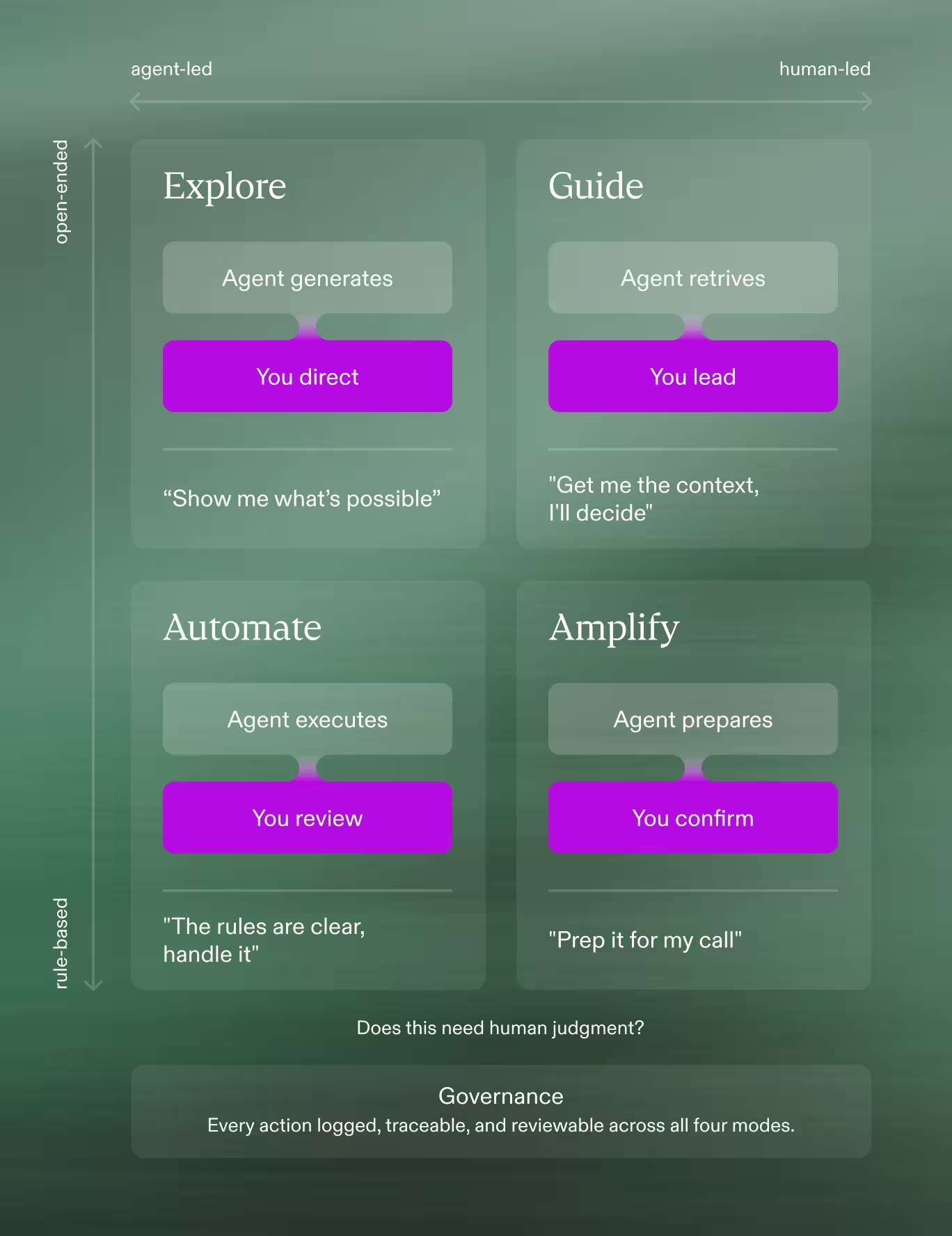
Automate is for rule-based work governed by clear standards such as compliance checks, asset tagging, and workflow triggers. The agent executes against machine-readable brand rules, and the human can review and intervene at any time. Every action is logged, and every decision is auditable. That visibility is the boundary between trusting the agent and handing over control.
Explore is for open-ended work that still has to follow clear brand rules, such as copy variants, campaign concepts, and visual explorations. The agent generates options grounded in brand truth, and the human directs. The output is plural by design: not a single answer, but a range of possibilities for a person to choose from.
Guide is for the highest-stakes work, when there are no hard rules, and human judgment is imperative: brand strategy, positioning decisions, stakeholder calls, and crisis response. There’s no defined standard for the agent to recommend against, because the standard is what the human is constructing. The agent retrieves history, context, and signals, and the human leads.
Amplify is for the moments where a defined standard exists, but the call still belongs to a person. Campaign reviews, guideline application, and template adaptation are examples of this type of collaboration. The agent prepares a recommendation against the standard, but it would be too risky to let it run on its own. The human makes the decision on whether to confirm or override.
All four collaboration modes need governance underneath them as a foundational layer to work. Agents must be trained on brand truth, monitored through compliance signals, and refined as the brand evolves. As agent-to-agent workflows emerge, traceability must extend to the machine layer. Every interaction in the chain stays logged and reviewable, so accountability does not disappear just because no one is watching.
Transparency and traceability are the cornerstones of trust. And without trust, the foundation for effective collaboration quickly erodes.

Designing AI for brand work
The Human-Agent Collaboration Framework helps us scrutinize the nature and purpose of brand-related tasks to truly understand how AI can support humans and take work off their plates. What would brand practitioners want and expect from AI agent collaborators in a particular moment? Think of it as if you were asking a friend for a recipe recommendation, and the person abruptly took over your kitchen and baked you a cake. It could be a delightful surprise, but it could equally be seen as overstepping or intruding.
Confidence in AI does not come from automating uncritically. It comes from knowing exactly what can be handed off to AI and where the human still leads.
The framework's purpose is to deploy AI where it earns its keep while supporting collaboration on the terms of human beings.
At Frontify, this is how we approach every AI solution in our product: We scrutinize the level of autonomy suited for agents when collaborating with humans, depending on the nature of the tasks and goals.
AI agents earn human trust by behaving in line with what humans expect of them. Agents also need to be transparent in how they operate: No mode is a black box. Sometimes agents should act; other times, recommend or retrieve. AI can assist the brand, but it should never own it.