
When innovation week meets everyday basics
Sparks is Frontify's annual innovation week. It's the one week each year when product teams step away from the roadmap to explore radical ideas, emerging tech, and "what if?" prototypes. The kind of thing you'd expect to show off on stage.
So when our team landed on building a trash can for the DAM, I felt the irony immediately. Other teams were exploring AI agents and conversational interfaces. We were working on a trash can.
Here's the thing I kept coming back to that week. The most exciting bets in a product portfolio aren't always the loudest ones. Sometimes the work that earns the most trust is the work that pays close attention to the moments most people take for granted. Like the moment you click "delete."
What a trash can actually means in the DAM
Deletion is one of the highest-stakes interactions in any content system. A single click can erase work that took weeks to produce, and there's rarely an easy "oh no" path back to where you were. We've heard from customers that this moment deserves more care, and Sparks gave us a chance to give it that care.
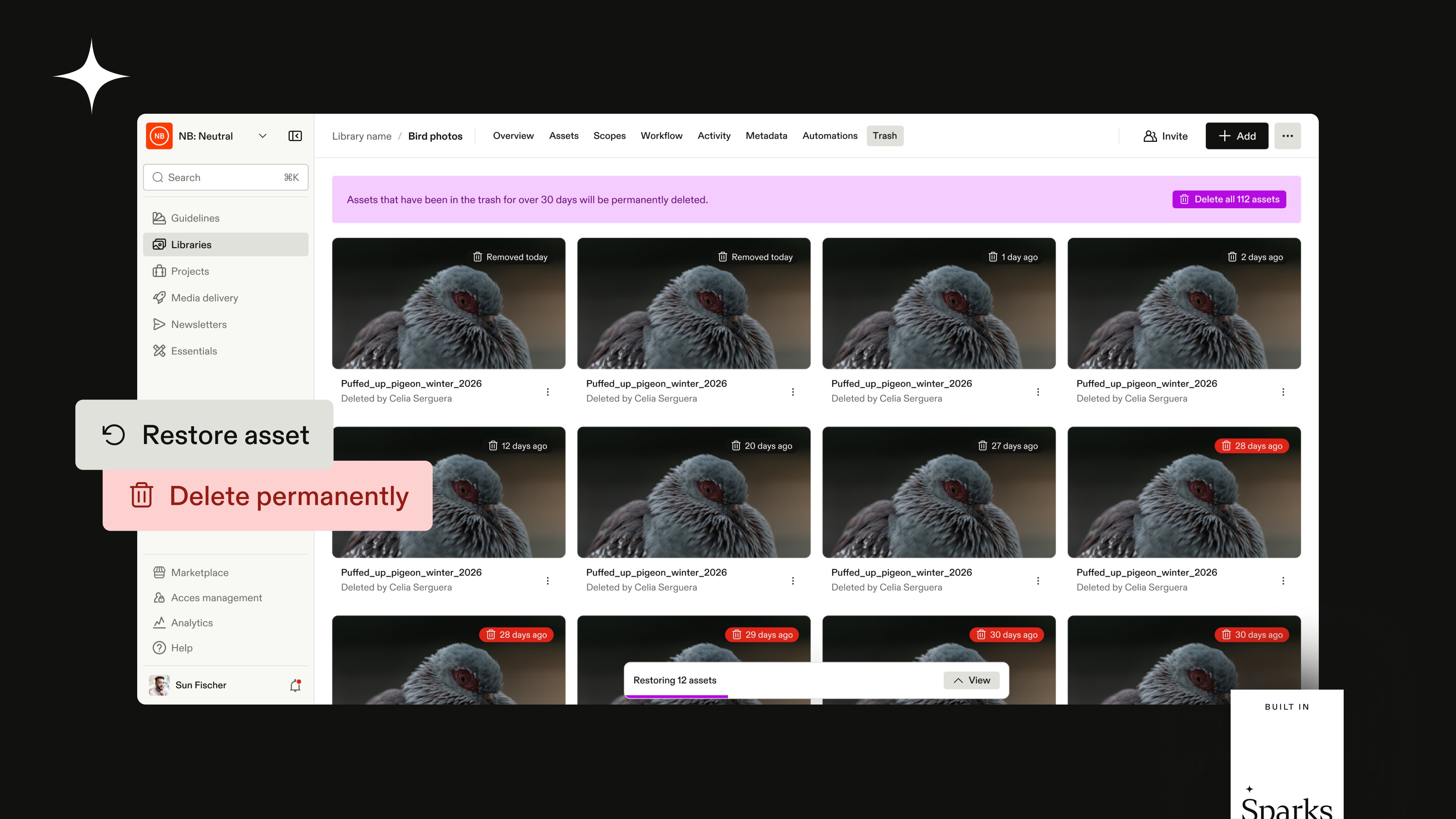
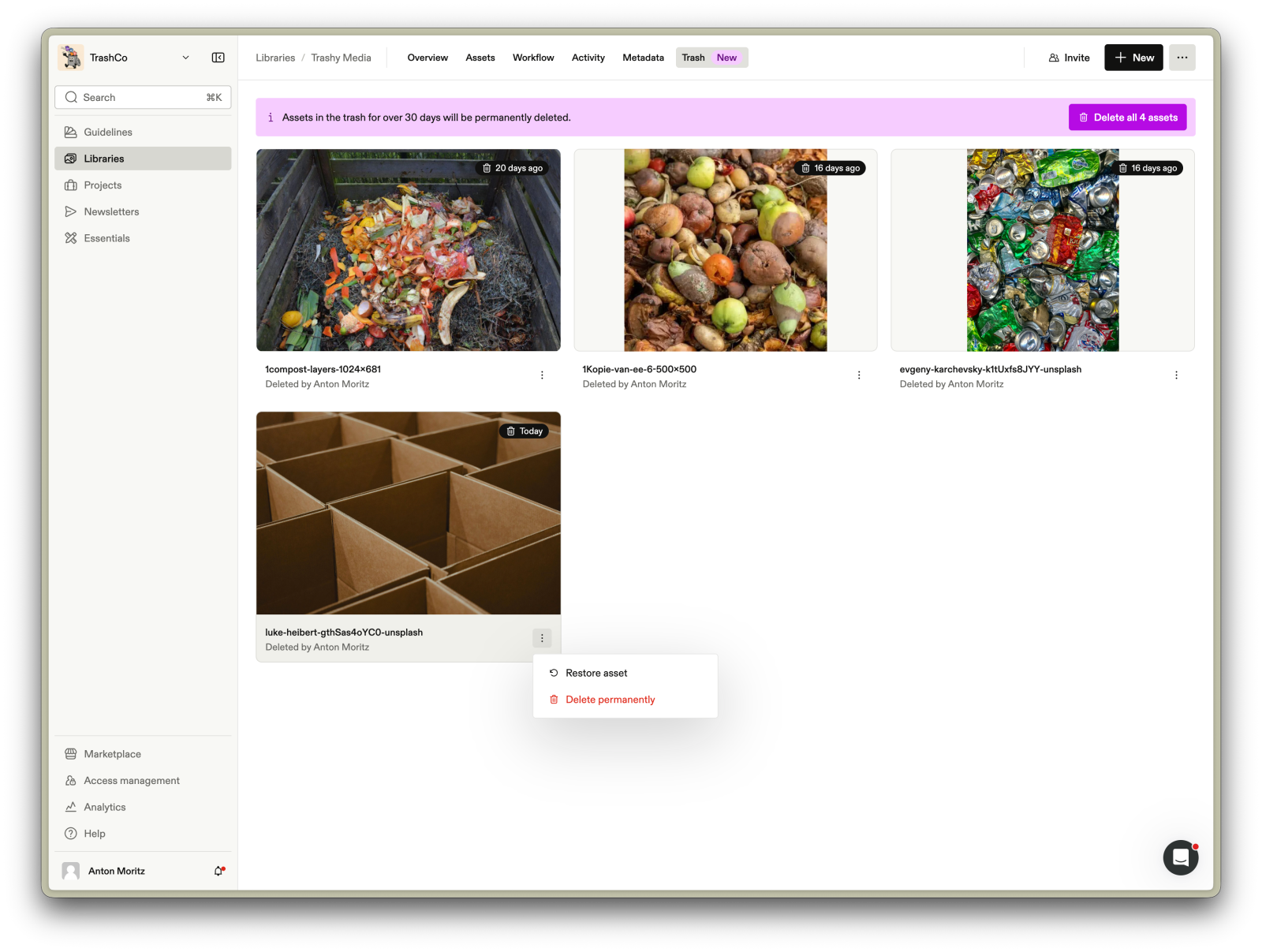
We built Trash — a trash view inside every library. Delete an asset, and it moves to Trash instead of vanishing. You can browse what's been deleted, see who deleted it and when, use Restore to bring single assets back to their original location (including their collection membership), or Delete permanently when you're sure. After 30 days, the system auto-purges anything that's still in Trash.
It's not glamorous. But it's the kind of foundational safety we want underneath every library customers entrust us with.
What we explored in five days
On Monday, as a new team coming together for the first time, we agreed on what success looked like by Friday. Some Sparks teams use the week for early concepts and prototypes. We wanted something different: a real, working piece of product, demoed live, and built to carry through to launch. That decision shaped the whole week.
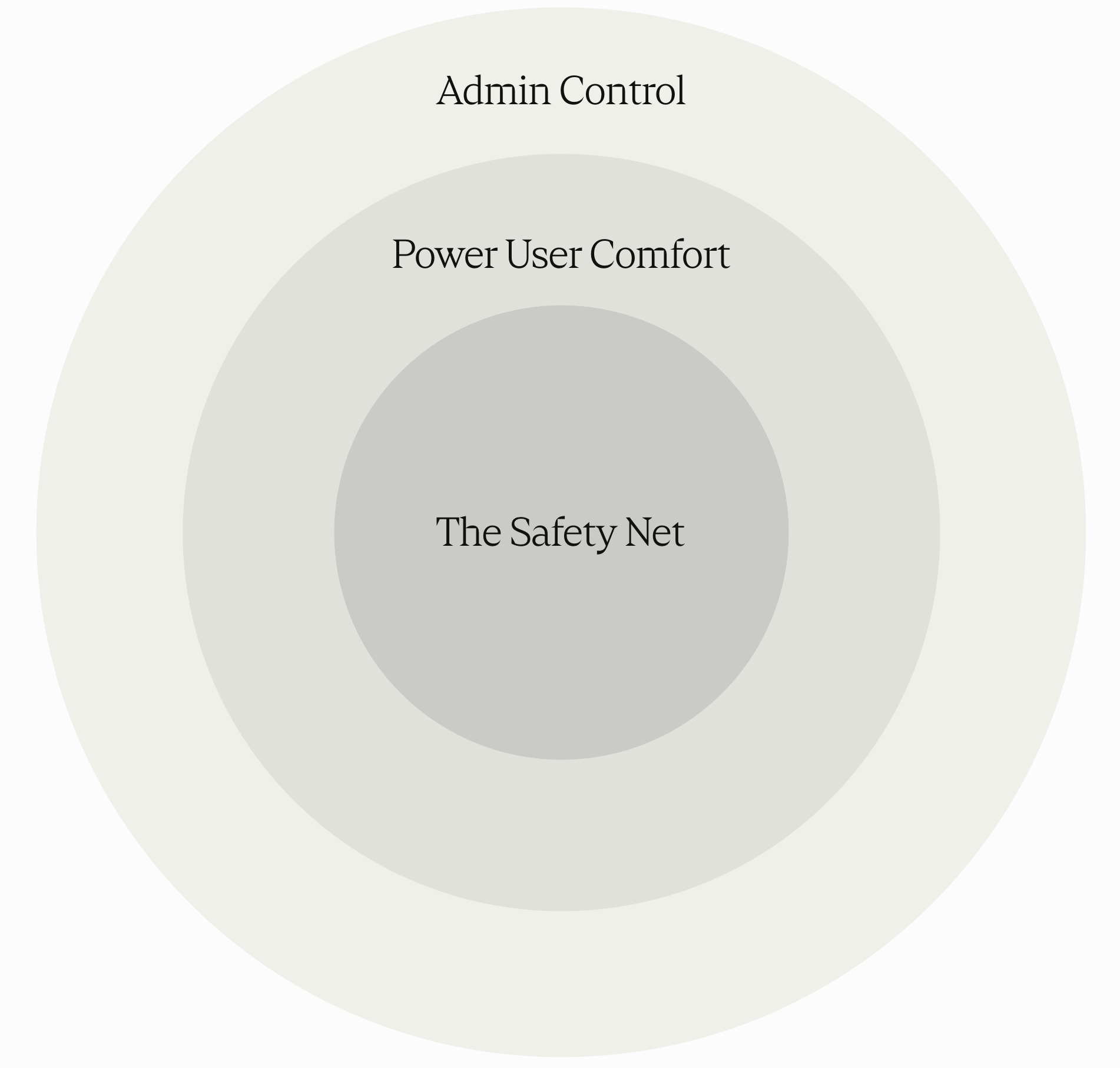
From there, we approached the work with scope rings: a simple way to sort what we wanted to build by how essential it was. Ring 1 was the safety net, the smallest thing that solves the core problem. Outer rings were the nice-to-haves we'd pull in if we had time. By Monday afternoon we'd committed to a Ring 1 that was honestly pretty ambitious for a one-week sprint.
By Friday, all of it was working. Trash was live across every library type, with restore that brought assets back to their original location and collection membership, permanent delete for when you're sure, and a 30-day auto-purge running quietly in the background. Every card showed who deleted what and when. And in the moment right after deletion, an undo banner caught the "wait, no" reflex before the case became a support ticket.
We demoed Trash live on stage, deleting and restoring assets from a (very on-theme) TrashCo brand library full of stock photos of dumpsters.
The biggest surprise of the week wasn't technical. It was how much faster the team moved when we replaced "what should we build" with "which ring are we landing on." Flexibility to reduce scope made it easier to commit to scope. That's something I'm bringing back to my home team.
Where it's going from here: There's plenty we didn't get to. Folder-level trash, bulk actions, a cross-library view, search and filter inside Trash, a proper audit trail. Those are now in good hands with the DAM Team, who'll carry it to launch. The handoff was clean because we built on the real architecture from day one.
What's still open
The week's work is the starting line, not the finish line — and the team is taking it the rest of the way.
Recoverable deletion at the asset level opens up a bigger design space: folder-level trash, bulk actions, a cross-library view, search and filter inside Trash, a proper audit trail. The foundation is in place, and it's now in good hands with the DAM team to carry to launch. The handoff was clean because we built on the real architecture from day one.
Innovation week isn't only about building things nobody has seen before. Sometimes it's about choosing to spend a week protecting the work our customers care most about, with the kind of UX that quietly removes a daily worry.